
How to Prioritize AEO Fixes Using Buyer Evidence
Michelle Perkins, Founder of ValueTempo
TL;DR
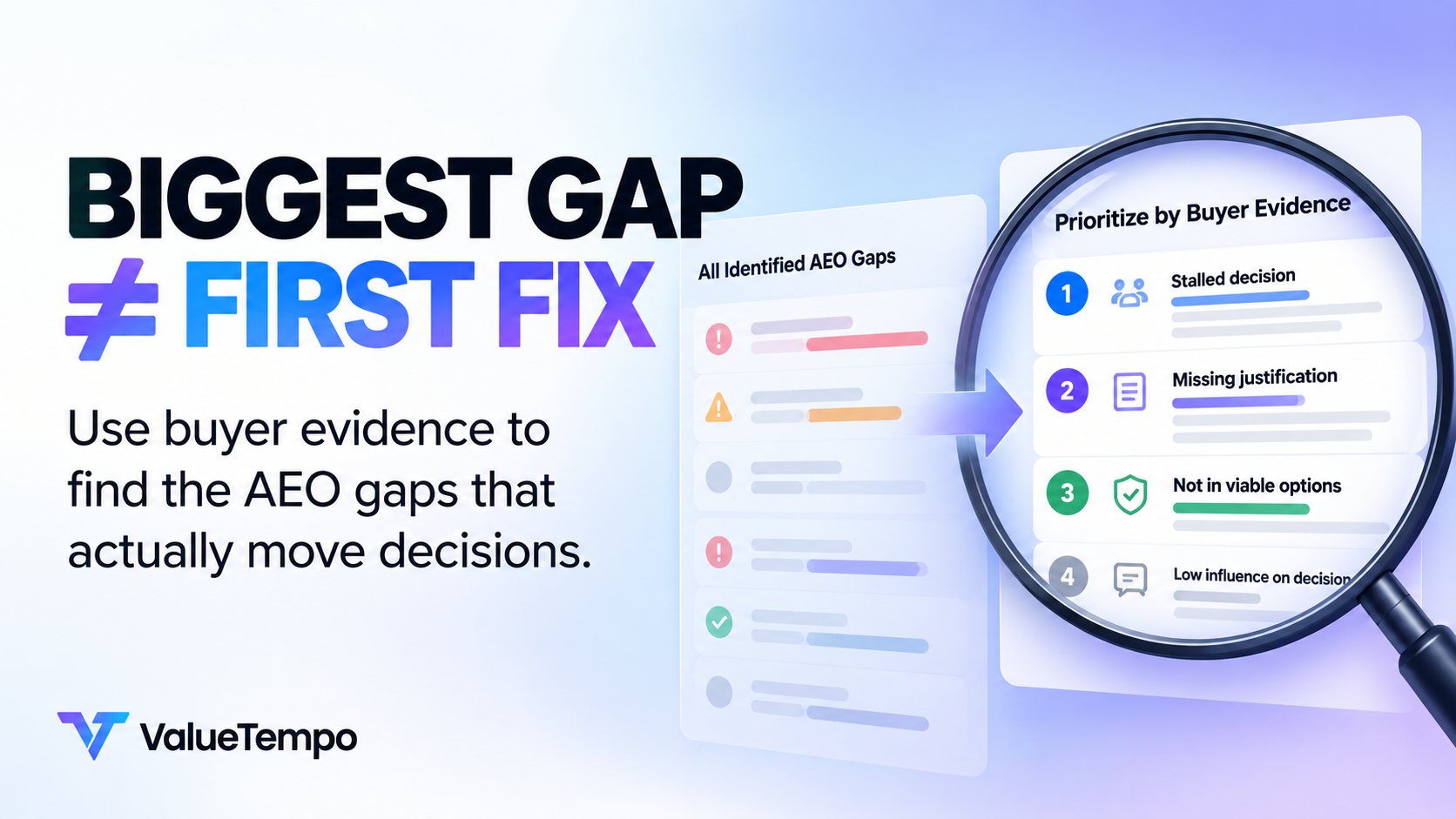
Don’t prioritize AEO or GEO fixes by visibility gap alone. Start with the ICP-fit buyer decision you need to influence, identify the evidence gap that may be constraining it, and test one credible intervention. Measure answer-engine outcomes—such as visibility, citation, candidacy, and selection—separately from downstream buyer signals. Then use the result to decide what to continue, revise, stop, or reprioritize.
The largest AEO visibility gap is not automatically the highest-priority fix. Prioritize an AEO opportunity by connecting it to an ICP-fit buyer decision, defining the answer-engine outcome that needs to change, selecting one credible evidence intervention, and tracking answer-engine and buyer signals separately.
AI visibility platforms can help teams identify declining prompts, differences across answer engines, citation sources, competitor movement, and page-level weaknesses. The operator's job is to decide which finding deserves GTM resources.
The same prioritization problem applies whether a team calls the work answer engine optimization (AEO), generative engine optimization (GEO), or AI search optimization.
This guide provides a practical method for making that decision.
Why AEO visibility gaps need commercial context
An AEO dashboard may surface dozens or hundreds of opportunities:
- a declining prompt
- a lost citation
- a competitor gaining mentions
- a brand missing from a candidate set
- an inaccurate product description
- a page that is difficult for an answer engine to extract
- an answer that changes across engines or repeated runs
These findings are not commercially equal.
A broad discovery prompt can have a large visibility gap but little demonstrated connection to qualified evaluations. A smaller evaluation-stage gap can affect a capability repeatedly raised in active deals.
The second gap may deserve priority because it is closer to a buyer decision the company wants to influence.
This is the difference between optimizing for the largest measurable gap and optimizing for buyability: whether an ICP-fit buyer has the evidence needed to evaluate fit, justify the cost, reduce risk, and move forward.
What AEO platforms can diagnose
Current platforms give operators several useful diagnostic views:
- Profound documents visibility analysis by platform, topic, prompt, region, persona, and competitor, along with citation- and answer-level inspection.
- Semrush documents AI visibility benchmarking, prompt research, daily prompt tracking, competitor analysis, and technical audits for issues that could block AI crawlers.
- Scrunch documents prompt-level answer monitoring and citation analysis by platform, persona, funnel stage, topic, country, and citation owner.
These product documents establish available diagnostics. They do not establish that acting on a tool recommendation will change an answer-engine recommendation, buyer behavior, pipeline, or revenue.
Use a platform to investigate the gap. Use source analysis to understand the evidence environment within each engine. Use buyer and commercial evidence to establish the priority.
The six AEO outcomes operators should measure separately
“AI visibility” often combines outcomes that require different evidence and interventions.
| Outcome | What it means | What it does not establish |
|---|---|---|
| Visibility | The brand or domain appears in the monitored answer environment | Citation, preference, or buyer action |
| Citation | A page is used or linked as a source | That the publisher's brand is considered or recommended |
| Brand presence | The brand is named in the answer | Positive framing, candidacy, or selection |
| Candidacy | The brand is included among viable options for the defined buyer | First choice or buyer preference |
| Selection | The answer engine chooses or ranks the brand first | Purchase, pipeline, or causal influence |
| Buyer response | The buyer searches, visits, asks, progresses, or acts after exposure | That the AEO intervention caused the behavior |
Kevin Indig's August 2026 observational study helps explain why these distinctions matter. Using Semrush data across 1,094 categories and five prompt variants per category, the broader study included 283,215 citation observations and 76,493 named-brand-mention observations from U.S. ChatGPT results between January and June 2026. The relatedness comparison below used 45,578 expansion appearances from 1,458 mapped brands.
In categories semantically distant from a brand's established expertise, 50% of appearances involved citations and 25% involved named mentions. In close categories, 74% were cited and 44% were named. Citation-only presence was nearly constant: 41% in distant categories and 40% in close categories.
The study measured citations and named-brand mentions—not recommendation, preference, selection, or buyer action. Its regression models included controls, but the results remain associations rather than causal effects from content or category expansion.
This is not an argument for expanding into distant categories. The comparison matters because it helps isolate two behaviors: a domain being used as evidence and its brand being named in an answer.
The defensible implication is that evidence authority and brand authority can differ. A domain may be used as evidence without its publisher's brand being named in the answer. Whether that changes candidacy or preference requires separate testing.
A four-question framework for prioritizing AEO fixes
1. Which buyer decision matters?
Start with three fields:
- GTM goal: What commercial motion should improve?
- ICP: Which buyer or account profile matters?
- Journey stage: Is the question about discovery, evaluation, or purchase readiness?
Then identify the decision represented by the prompt.
| Journey stage | Typical buyer task | Example AEO question |
|---|---|---|
| Discovery | Understand a category or approach | What types of AI-search platforms exist? |
| Evaluation | Compare viable providers against requirements | Which AI-search platforms provide historical tracking for a mid-market SaaS team? |
| Purchase readiness | Resolve implementation, risk, cost, or procurement concerns | Which platform supports Salesforce integration and historical reporting under the approved budget? |
Prompt portfolios should include both broad coverage and deeper compound questions. The deeper questions combine the category with the ICP, evaluation criteria, constraints, or comparisons that shape an actual decision.
AthenaHQ's September 2026 enterprise guide offers similar practitioner guidance: derive prompts from buyer research, sales objections, support themes, product terminology, and related business context; then assign each prompt an audience, funnel stage, and business purpose. Treat this as an operating recommendation, not controlled evidence of commercial impact.
Do not include brand names when the goal is to measure unprompted candidacy or selection. A named-brand prompt answers a different question.
2. What outcome needs to change?
Define the current state and target state explicitly.
Examples:
- citation absent → cited consistently
- inaccurate capability description → accurate description
- brand absent from viable options → included for the defined buyer
- included but rarely selected → selected more consistently
- inconsistent answer-engine result → repeatable change under comparable conditions
Check the outcome by engine and across repeated runs. Model, browsing state, reasoning mode, prompt wording, geography, and timing can affect the answer environment. Hold variables constant where possible and record those you cannot control.
3. Which intervention is worth testing first?
Evaluate each candidate fix using four criteria:
| Criterion | Operator question |
|---|---|
| Commercial relevance | Does this affect a decision made by an ICP-fit buyer? |
| Evidence strength | Is the issue repeated in deals, demos, support, product usage, or buyer research? |
| Intervention quality | Can we improve the evidence accurately and credibly? |
| Effort and risk | What will the change require, and what could it disrupt? |
Use the criteria as a decision aid, not a universal weighting formula. A legal or technical constraint may outweigh a high visibility opportunity. A factual misrepresentation affecting active evaluations may outrank a larger discovery-stage gap.
4. What result would justify continuing?
Predeclare the expected answer-engine outcome before making the change.
Examples include:
- accurate capability representation in at least two relevant engines
- repeatable citation across a defined prompt set
- more consistent inclusion among viable providers
- more stable first-choice selection for the defined buyer context
Then define the downstream buyer signal to observe separately:
- fewer integration clarification questions
- more visits to implementation documentation
- more self-guided demo activity related to the capability
- progression after the concern is addressed
- changes in branded search or direct traffic, where measurable
These signals create a traceable sequence. They do not prove that the AEO intervention caused the buyer outcome.
Worked example: when the smaller visibility gap should win
Assume a SaaS company has two items in its AEO backlog.
Opportunity A: broad category visibility
- Largest measured visibility gap
- Discovery-stage prompt
- No repeated evidence that the prompt affects qualified evaluations
- Proposed fix: improve a generic category comparison page
Opportunity B: inaccurate integration information
- Smaller set of evaluation-stage prompts
- Relevant AI answers omit or misstate a required integration
- The integration is repeatedly raised in qualified deals
- Proposed fix: publish verified integration guidance
Opportunity B should be tested first.
It has a clearer relationship to the GTM goal, ICP, buyer stage, and observed evaluation friction. It also supports a narrow intervention and two defined checks:
- Answer-engine check: Do relevant answers describe the integration accurately?
- Buyer check: Do ICP-fit buyers still need clarification before moving forward?
If answer accuracy improves and the buyer concern remains, do not declare failure or success too quickly. The content intervention may have fixed the representation problem while product fit, implementation complexity, trust, pricing, or another issue continues to constrain the decision.
What ValueTempo's controlled experiment added
ValueTempo first used seven natural buyer questions to surface providers that appeared in the VAT-compliance candidate environment.
We then ran 36 controlled evaluations with a fixed buyer and fixed candidate set. The same provider ranked first across the runs even as supporting evidence and rationale varied.
The controlled runs did not measure whether a provider would naturally enter the candidate set; the candidates were already fixed. They also did not establish buyer preference, pipeline impact, or causality.
The operational learning was more specific:
- In these runs, selection remained stable while the supporting explanation changed.
- Measuring only the winner can hide evidence instability.
- Measuring only rationale changes can exaggerate their commercial importance.
- Repeated runs under comparable conditions help distinguish a meaningful pattern from answer variability.
The resulting measurement sequence is:
visibility → citation → brand presence → candidacy → selection → buyer response
How to close the AEO learning loop
An AEO test is not a learning loop until the result changes the next decision.
Use this operating sequence:
- Investigate: Identify the prompt, engine, source, page, or representation gap.
- Prioritize: Connect the gap to an ICP-fit buyer decision and GTM goal.
- Intervene: Change one evidence element where possible.
- Retest: Evaluate the intended answer-engine outcome under comparable conditions.
- Observe: Track relevant buyer signals separately.
- Update: Continue, stop, revise the hypothesis, or reprioritize the backlog.
This closes the connection across the ValueTempo APPP framework:
- APPEAR: Is the brand or its evidence present?
- PREFER: Is the gap tied to a buyer and decision worth influencing?
- PROVE: Did a defined intervention produce a repeatable answer-engine change?
- PERFORM: What downstream signal followed, and what can the evidence support?
AEO/GEO Fix Priority Worksheet
Use one worksheet per candidate intervention. The goal is not to score every AI-search gap mechanically. It is to decide whether a gap is commercially important enough to test, define what should change, and preserve what the result should teach the next decision.
1. Commercial context
- GTM goal: What commercial motion should improve?
- ICP or buyer segment: Which buyer or account profile matters?
- Journey stage: Discovery / Evaluation / Purchase readiness
- Buyer decision: What decision is the buyer trying to make?
2. Diagnose the gap
- Prompt or prompt cluster: Which buyer question exposes the issue?
- Relevant answer engine(s): Where does the gap appear?
- Observed AEO/GEO gap: What is missing, inaccurate, unstable, or underrepresented?
- Outcome type: Visibility / Citation / Brand presence / Candidacy / Selection / Accuracy
- Buyer or operator evidence: Where else does this issue appear—in deals, demos, support, product usage, or buyer research?
3. Establish priority
- Commercial relevance: Does this affect a decision made by an ICP-fit buyer?
- Evidence strength: Is the issue repeated across credible buyer or operator evidence?
- Intervention quality: Can the evidence be improved accurately and credibly?
- Effort and risk: What will the change require, and what could it disrupt?
4. Priority decision
Test now / Validate first / Monitor / Deprioritize
Decision rationale: Why does this gap deserve—or not deserve—resources now?
Do not turn these criteria into a universal weighted score. A factual error affecting an active evaluation can deserve priority over a quantitatively larger discovery-stage visibility gap.
5. Define the test
- Hypothesis: If we improve this evidence, what answer-engine outcome do we expect to change, for which buyer context?
- Proposed evidence intervention: What one evidence element will change?
- Expected answer-engine outcome: What observable result would support the hypothesis?
- Downstream buyer signal: What buyer behavior or commercial signal should be observed separately?
- Controls and repeat plan: What should remain constant, and how many comparable runs will be used?
- Owner and intervention date: Who owns the intervention and when will it be tested?
6. Record the learning
- Answer-engine result: What happened in the answer environment?
- Downstream buyer observation: What happened in the buyer or commercial signal?
- What did we learn?: Did the evidence support, weaken, or complicate the hypothesis?
- Next decision: Continue / Stop / Revise / Reprioritize
- What changes next?: What should the team—or its AI systems—carry forward into the next decision?
The worksheet is designed to preserve the full learning chain:
buyer evidence → hypothesis → priority decision → intervention → answer-engine response → buyer signal → learning → next decision
Put the framework to work
Use the free AEO/GEO Fix Priority Worksheet to connect an AI-search gap to a buyer decision, choose what to test, and record what you learn.
What AEO attribution can and cannot show
An AEO program can often create a traceable sequence:
finding → intervention → answer change → subsequent buyer signal
That sequence is useful for learning.
A June 2026 non-peer-reviewed observational preprint from Scrunch-affiliated researchers linked opt-in clickstream data with the same users' ChatGPT, Claude, and Gemini conversations. The analysis found that recommendations to previously unengaged users were associated with later branded searches and visits. But the study did not observe transactions and was not randomized. It also found that a naive all-mention funnel was confounded by references to brands users already knew.
For operators, the implication is straightforward: distinguish recommendations from incidental mentions, account for prior brand engagement, define the downstream outcome, and avoid treating last-click or temporal sequence as proof of causality.
Frequently asked questions
What is AEO prioritization?
AEO prioritization is the process of deciding which AI-search visibility, citation, representation, candidacy, or selection gap deserves action first. A buyer-led approach considers ICP fit, journey stage, commercial relevance, evidence strength, intervention quality, effort, and risk.
Does this prioritization framework apply to both AEO and GEO?
Yes. AEO typically focuses on making information understandable and extractable for direct answers, while GEO focuses more broadly on how brands, claims, and sources appear in generated responses. The same prioritization method applies to both: connect the observed gap to an ICP-fit buyer decision, define the outcome that should change, test a credible evidence intervention, and track answer-engine and buyer outcomes separately.
Should the largest AI visibility gap be fixed first?
Not automatically. A smaller gap can deserve priority when it affects a requirement repeatedly raised by ICP-fit buyers, constrains an active evaluation, or can be addressed through a credible and testable evidence intervention.
Are citations and brand recommendations the same AEO outcome?
No. A citation indicates that an answer uses or links to a source. A brand mention indicates that the brand is named. Candidacy means the brand is treated as a viable option for a defined buyer. Selection means it is chosen or ranked first. These outcomes should be measured separately.
How should an AEO fix be tested?
Define the target outcome before changing the evidence. Retest a controlled prompt set across repeated runs, holding the buyer context, prompt, model, candidate policy, and browsing or reasoning settings constant where possible. Preserve the raw answers and record environmental changes.
Can AEO performance be attributed to pipeline or revenue?
Sometimes specific referrals or self-reported buyer paths can be observed, but visibility, citation, or selection alone does not establish pipeline influence. Track answer-engine and buyer outcomes separately, preserve timestamps and segments, and use the strongest attribution method the data supports.
Sources
External evidence
Product capabilities and practitioner guidance
Also useful reading — A four-part AEO series:
- APPEAR: Being Cited Is Not Being Chosen: How AI Answer Engines Build B2B Consideration Sets
- PREFER: From Consideration to Preference: How AI Answer Engines Choose Among Credible B2B Brands
- PROVE: AI Keeps Recommending Your Brand. How Strong Is the Case Behind It?
- PERFORM: The AI Answer Changed. Did the Buyer?
- Buyability: Assess your buyability gap here.