
The AI Answer Changed. Did the Buyer?
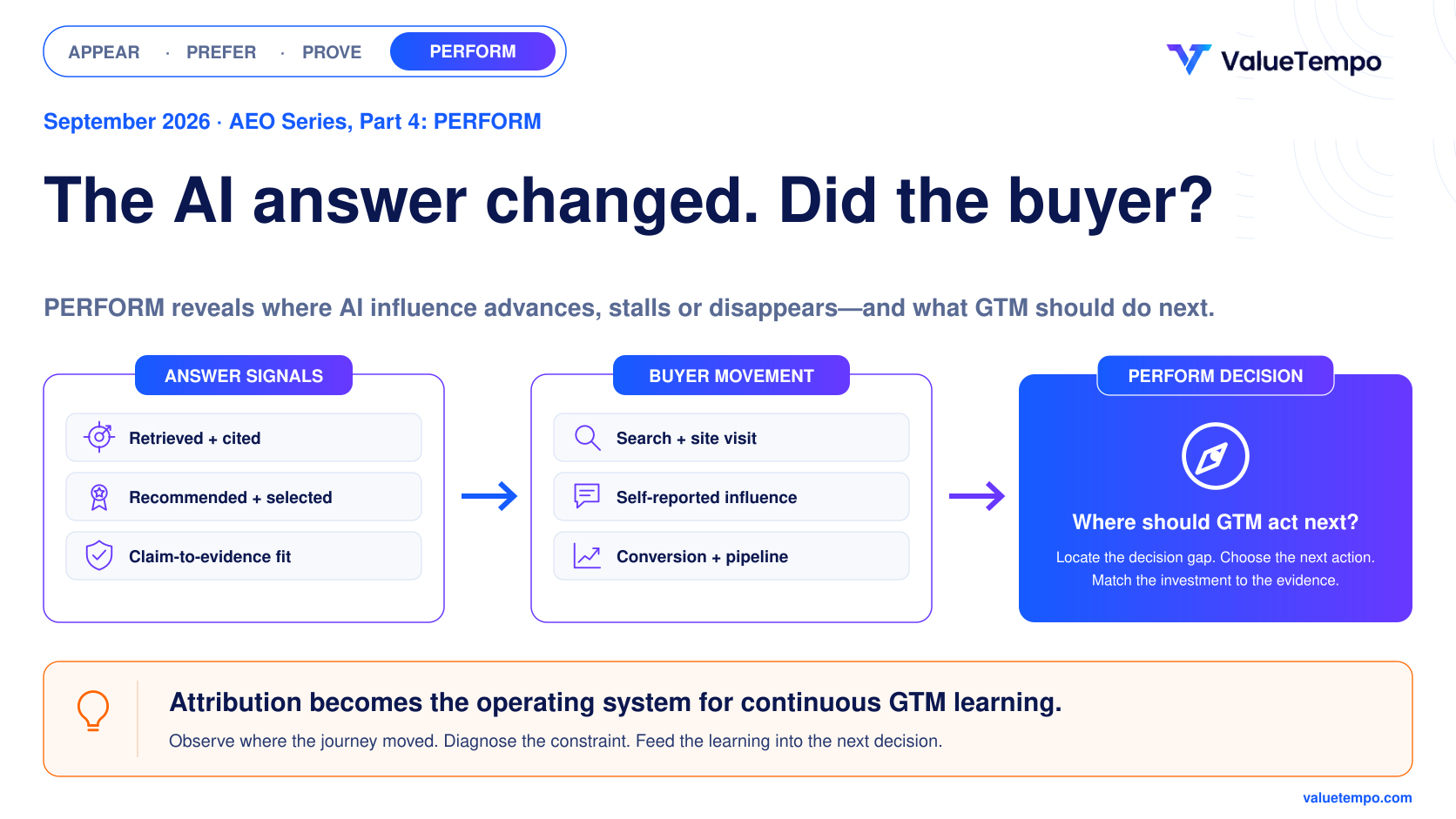
PERFORM uses attribution signals to reveal where AI influence advances, stalls or disappears—and what GTM should do next.
Michelle Perkins, Founder of ValueTempo
TL;DR
AEO attribution gives GTM teams a decision map: where AI influence appears to advance the buying journey, where momentum stalls and which gap to address next. Retrieval, recommendation, evidence quality, referral, self-report, conversion and pipeline each illuminate a different transition. PERFORM connects these signals into a continuous learning loop so teams can diagnose constraints, choose and test interventions, and scale what the evidence supports. Used this way, attribution becomes a GTM operating system for deciding where to invest, what to change and when a credible comparison justifies claiming incremental impact.
The first three parts of this series stayed inside the AI answer.
We tested whether a VAT-compliance provider appeared in the consideration set, which provider became the preferred choice and whether the evidence behind that preference addressed the buyer's actual requirements.
Then the experiment reached its boundary.
The answer engine had made a recommendation. We did not know whether a buyer visited the provider, searched for it later, added it to an evaluation, started a sales conversation or purchased.
That missing connection is usually described as an attribution problem. But “How much revenue should AI receive credit for?” is not the first—or most useful—question.
The more useful question is:
What can each attribution signal tell us about where AI is affecting the buying journey—and which GTM decision should follow?
That is the role of PERFORM.
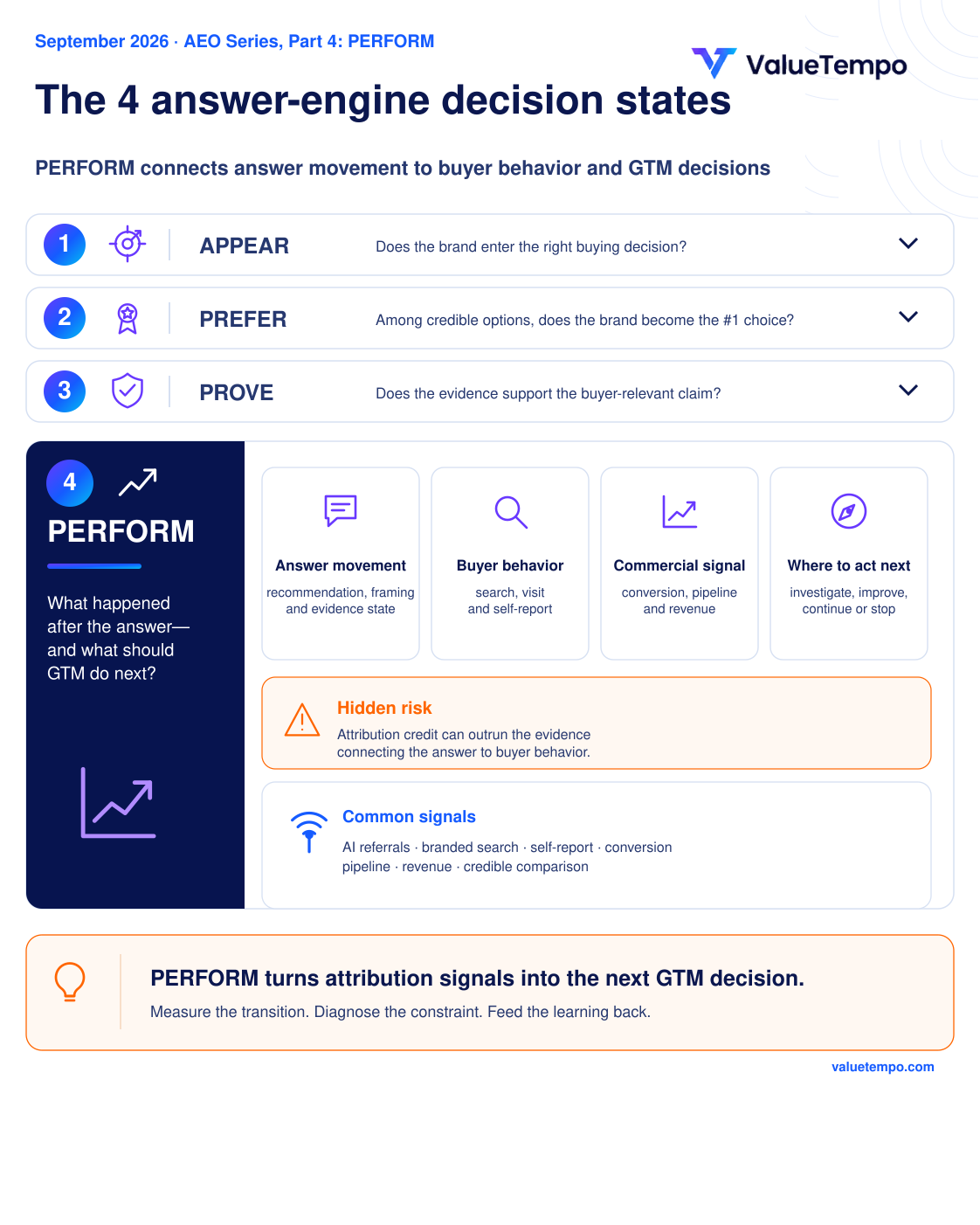
PERFORM connects answer-engine movement with buyer and commercial behavior so the next GTM action addresses the actual decision gap.
The first three tests revealed three different kinds of movement
ValueTempo's four-part framework separates decisions that often get compressed into one AEO visibility score.
APPEAR: Did the brand enter the decision?
In our open VAT-compliance test, one provider made the final three in 11 of 12 fresh-session runs and became the #1 choice 10 times. Another credible provider appeared 10 times but was never selected.
The first lesson was simple: a citation, a mention, a place on the shortlist and the final recommendation are different outcomes.
APPEAR therefore asks whether the brand reliably enters the right consideration set for the right buyer—not merely whether it is visible somewhere in an answer.
PREFER: What made one credible option become the first choice?
We then fixed the buyer requirements and candidate set. ChatGPT, Claude, Gemini and Perplexity all selected the SaaS-oriented provider.
The broader enterprise platform had more institutional presence and extensive documentation. The managed-compliance option offered a different service model. Neither displaced the provider whose evidence most closely matched this buyer's SaaS operating context.
PREFER showed why share of voice is incomplete. The important question is not only whether the brand appeared, but how the engine matched its evidence, tradeoffs and category position to the buyer.
PROVE: Did the evidence support the reason for choosing it?
The 36-run controlled experiment went one level deeper. We supplied three cumulative evidence conditions: owned facts; owned facts plus external corroboration; and both of those plus limitations and delivery boundaries.
The same provider won all 36 runs. Yet parts of the evidence trail, requirement ratings, qualifications and stated confidence changed.
The engines sometimes used setup time, partner involvement, customer reviews or product structure to infer ongoing finance-team workload. Those conclusions sounded plausible, but the evidence did not directly establish who would own recurring work, exceptions or partner coordination.
PROVE revealed a distinction a recommendation-only metric would miss: the winner can stay the same while the quality and relevance of the case behind it changes.
Together, the first three stages give PERFORM its upstream inputs.
| Decision state | Signal produced | GTM question |
|---|---|---|
| APPEAR | Retrieval, mention, shortlist inclusion and stability | Are we entering the right buying decisions consistently? |
| PREFER | Recommendation position, comparative framing and selection | What makes us the preferred option for this buyer? |
| PROVE | Claim support, source roles, corroboration, boundaries and inference | Is the recommendation based on evidence relevant to the buyer's actual decision? |
| PERFORM | Buyer behavior, conversion, pipeline, revenue and incrementality | Did the upstream movement matter—and what should GTM do next? |
Attribution should power the GTM learning loop
A useful body of GTM thinking already points in this direction.
Maja Voje argues that AEO is a cross-functional GTM capability, not a content project. Her operating model spans product marketing, content, brand, product, partnerships and sales. It tracks whether a brand is mentioned, recommended and described accurately, then connects those answer signals with referred traffic, conversion and pipeline.
The MKT1 team's broader attribution guidance supplies the critical purpose: attribution should inform what the GTM model does more of and what it needs to address—not determine who gets credit. Emily Kramer also warns that teams can spend so much time instrumenting attribution that they stop doing the work, and that first-touch reporting misses the multi-touch reality of B2B buying.
Alex Birkett makes the adjacent AEO case: use a constellation of self-reported attribution, AI referrals, server logs, visibility, branded search and direct traffic. Each signal is incomplete. Together, they can provide decision-grade evidence.
PERFORM connects these ideas:
AEO attribution creates value when it locates the constrained transition in the AI-mediated buying journey and helps the GTM team choose the next action.
That makes attribution a GTM operating system—a learning loop that observes where the journey moved, diagnoses the constraint, selects the next intervention and carries the result into the next decision.
Every attribution signal has a different job
Each attribution signal illuminates one part of the journey. Its value comes from matching that signal to the question and GTM decision it can support.
| Attribution signal | What it clarifies | GTM decision it supports | What it does not establish |
|---|---|---|---|
| Retrieval and citation | Whether evidence is accessible and being used | Fix technical access, distribution or content structure | Buyer awareness or preference |
| Mention and comparison inclusion | Whether the brand enters relevant answers | Improve category positioning and question coverage | Shortlist or selection |
| Shortlist and recommendation position | Whether the brand becomes a serious or preferred option | Strengthen differentiation, corroboration and tradeoff evidence | Buyer action |
| Recommendation stability | Whether the result persists across engines, prompts and repetitions | Decide whether to scale the intervention or investigate volatility | Commercial impact |
| Claim-to-evidence fit | Whether the recommendation addresses real buyer requirements | Create the missing proof object or correct unsupported framing | Buyer acceptance of the evidence |
| Direct AI referral | Whether an observable visit came from an AI platform | Improve landing paths, conversion and channel instrumentation | All AI-influenced traffic |
| Branded search, direct traffic and self-report | Whether indirect behavior may follow AI exposure | Improve nurture, sales discovery and cross-channel measurement | Causality on their own |
| Conversion and pipeline association | Whether AI-linked buyers advance commercially | Prioritize segments, journeys and offers with stronger outcomes | Incremental pipeline |
| Revenue joined to an AI-originated journey | How much revenue receives AI credit under a defined model | Inform channel investment and forecasting | Revenue that would disappear without the intervention |
| Controlled incremental lift | Whether an outcome exceeded a credible counterfactual | Scale, change or stop the tested intervention | Universal effectiveness beyond the test |
Match each signal to the decision it can support.
The important information often sits between the stages
A full-funnel AEO analysis should diagnose the transitions, not only report the levels.
Visibility increased, but recommendation did not
The brand may be cited more often without becoming more competitive.
Investigate whether the added visibility appears in commercially relevant questions, whether the brand is merely a source rather than a candidate and whether the evidence establishes meaningful buyer differentiation.
The next action may be a clearer category position, stronger comparative evidence or better buyer-context coverage—not more publishing volume.
Recommendation improved, but the supporting case remained weak
This is the PROVE problem.
The engine may choose the brand for a reason inferred from adjacent evidence rather than documented buyer outcomes. The response could require a responsibility map, an implementation boundary, a comparable customer example or an explicit statement of what remains unmeasured.
The next action belongs to product marketing, customer success, implementation or product—not necessarily the content team.
The answer improved, but buyer signals did not
Several explanations are possible:
- The monitored questions do not represent meaningful demand.
- The improved answer appears too rarely or inconsistently.
- The buyer learns enough inside the answer that no site visit follows.
- The next-step experience does not continue the decision.
- The recommendation does not translate into human preference.
- The influence occurs through a path the current instrumentation cannot observe.
The correct response is diagnosis, not automatically another AEO content intervention.
AI-linked traffic increased, but qualified pipeline did not
Now the constraint may have moved into the offer, conversion experience, qualification logic or sales process.
The team should compare landing paths, buyer intent, activation, qualification and opportunity progression—not claim success because a new referral segment appeared in analytics.
Pipeline increased, but the upstream answer state did not
Do not automatically credit the AEO intervention.
The commercial movement may be real, but the proposed mechanism is weak if the intended answer change never occurred. Other campaigns, market demand or platform-level growth may offer better explanations.
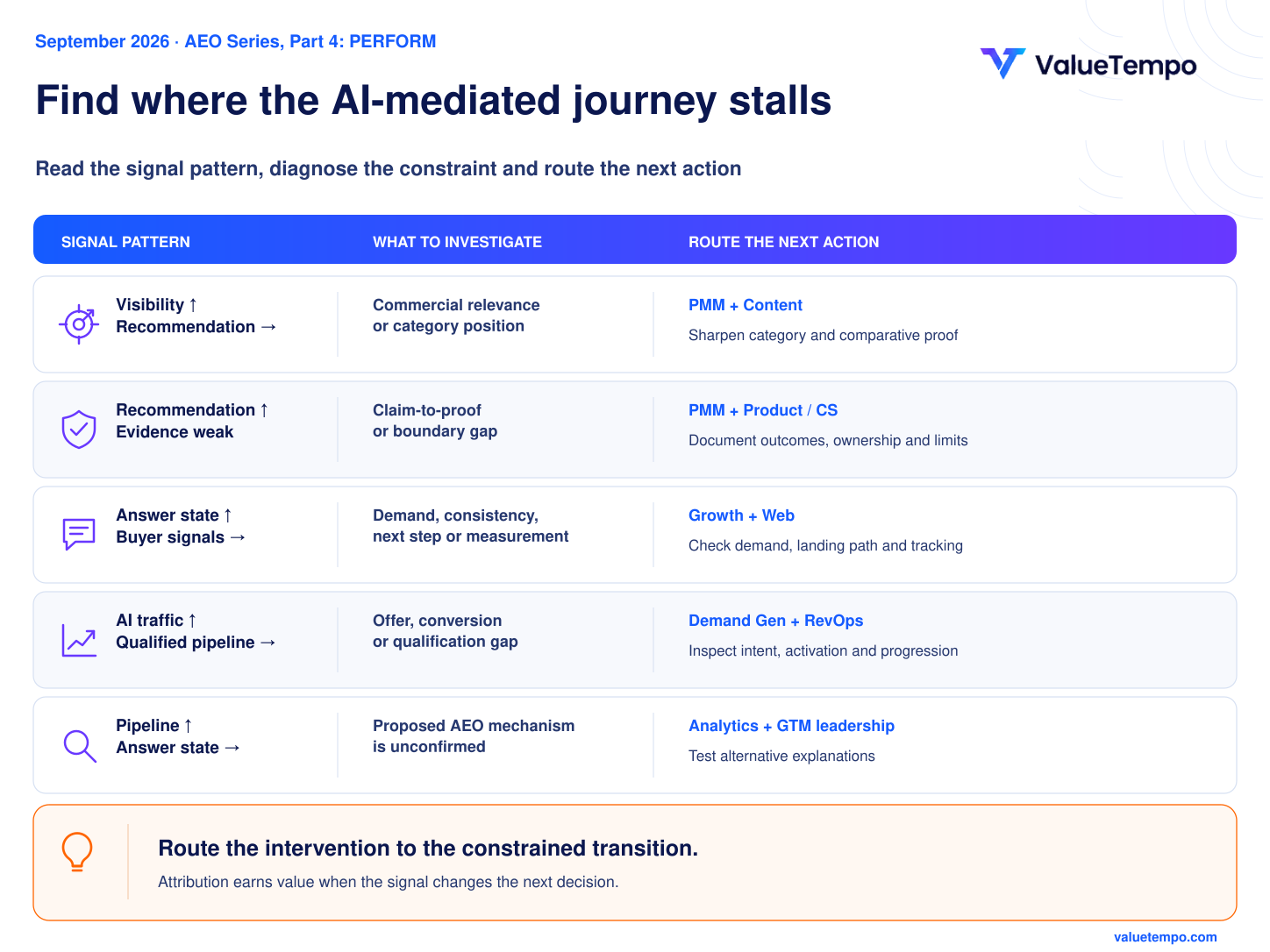
Attribution helps teams identify which transition to investigate and route the next action to the appropriate GTM function.
Current research is beginning to connect the answer with behavior
The external evidence no longer stops at citations.
Scrunch analyzed millions of opt-in AI conversations and subsequent web activities. In its observational panel, an AI recommendation to someone with no recent brand activity was followed by higher rates of branded Google search, brand-site visits and retailer-page views during the next week. Recommendations produced more downstream movement than passing mentions, and placement and framing mattered.
That strengthens the connection between PREFER and PERFORM: how the brand appears may matter, not only whether it appears.
But the measured outcomes were searches and visits—not purchases or revenue. The within-person comparison reduces some alternative explanations without creating a randomized exposure.
A separate audit of real purchase-advice conversations found the opposite side of the observation gap. Recommendations were common, but subsequent purchase decisions were rarely visible inside the conversation record. The absence of a recorded purchase was an unobserved outcome, not evidence that no purchase occurred.
Together, these studies explain why no single data source completes the journey. Answer monitoring sees the recommendation. Web analytics sees some visits. Buyers can report remembered influence. CRM and product systems see commercial progression. A stronger PERFORM system connects them without pretending each observes the same thing.
Attribution and incrementality answer different questions
Attribution connects an observed outcome to a source under a defined rule.
If a visitor arrives from ChatGPT, submits a demo request and later becomes revenue, the company can assign that journey to AI referral traffic under first-touch, last-touch or assisted attribution.
That is valuable. It shows an observable path and lets the team compare the quality of identifiable AI-originated journeys.
Incrementality asks a different question:
Would the outcome probably have happened without the AEO intervention?
The distinction becomes visible in a 2026 natural experiment on ChatGPT referral traffic. Referral traffic to the optimized pages increased 5.7 times. Untreated pages on the same domain increased 3.5 times over the same period as ChatGPT itself grew.
After using the untreated pages as a contemporaneous comparison, the estimated intervention-aligned increase was approximately 1.8 to 2.3 times. A conservative placebo test remained inconclusive, so the authors described the effect as suggestive rather than definitive.
The methodological lesson is more important than the multiple:
Raw post-intervention growth is not the treatment effect when the platform is growing too.
Attribution helps teams operate the channel. Incrementality helps them determine whether a particular intervention created additional impact.
GTM teams need both, but not for every decision at the same time.
Use attribution weekly. Raise the evidence standard with the decision
A modest evidence update does not need a randomized trial before it ships. A major budget shift or claim of incremental revenue needs more support.
A practical PERFORM system can separate four evidence lanes:
- Direct evidence: an identifiable AI referral followed by a site, product or CRM event.
- Self-reported evidence: the buyer says an AI answer influenced discovery, consideration or evaluation.
- Modeled evidence: analysis estimates a relationship between answer-state exposure and subsequent behavior while accounting for observed alternatives.
- Experimental evidence: a randomized or credible quasi-experimental comparison estimates the incremental effect of an intervention.
These are not four grades of the same data. They answer different questions.
Direct evidence preserves an observable journey but misses zero-click influence. Self-report recovers some of that influence but depends on buyer memory. Modeled evidence can estimate patterns but relies on assumptions. Experimental evidence supports the strongest causal conclusion but only for the tested treatment, period and population.
The evidence standard should rise with the consequence of the GTM decision:
| Decision | Minimum useful evidence |
|---|---|
| Correct inaccurate product framing | Repeated answer examples tied to identifiable source gaps |
| Update one evidence asset | Buyer-relevant claim gap plus a measurable answer-state hypothesis |
| Expand an AEO content pattern | Repeatable answer movement across a defined question cluster |
| Prioritize one buyer segment | Answer-state movement plus stronger behavior or pipeline signals from that segment |
| Reallocate meaningful GTM budget | Converging commercial signals and a credible contemporaneous comparison |
| Claim incremental revenue | Randomized or strong quasi-experimental evidence connected to the commercial outcome |
This approach avoids two bad extremes: demanding perfect causality before taking a reversible action, and treating every correlated movement as proof of ROI.
Verify, experiment and measure commercially
The operational distinction matters as AEO teams adopt more agents and automation.
StackedGTM's five-agent model, built around Profound monitoring and agent workflows, covers monitoring, consistency, reporting, distribution and brand standards. It closes an important execution loop: find the gap, ship the work and verify whether the answer environment responds.
PERFORM adds two questions that sit beyond that verification loop.
| Layer | Question | Evidence |
|---|---|---|
| Verify | Did the evidence or content reach the answer environment? | Retrieval, citation, mention, framing and recommendation monitoring |
| Experiment | Did the intervention change the intended answer state beyond normal variation? | Repeated baseline, controlled change, comparison and falsification rule |
| Commercial measurement | Did that answer-state movement correspond with buyer and business behavior? | Referrals, delayed behavior, self-report, conversion, CRM and revenue |
| Incrementality | Would the commercial outcome probably have occurred without the intervention? | Randomized holdout or credible quasi-experimental counterfactual |
Verification tells the team whether the work landed.
Experimentation tests whether it changed the answer.
Commercial measurement shows whether the answer movement mattered.
Incrementality supports the strongest investment claim.
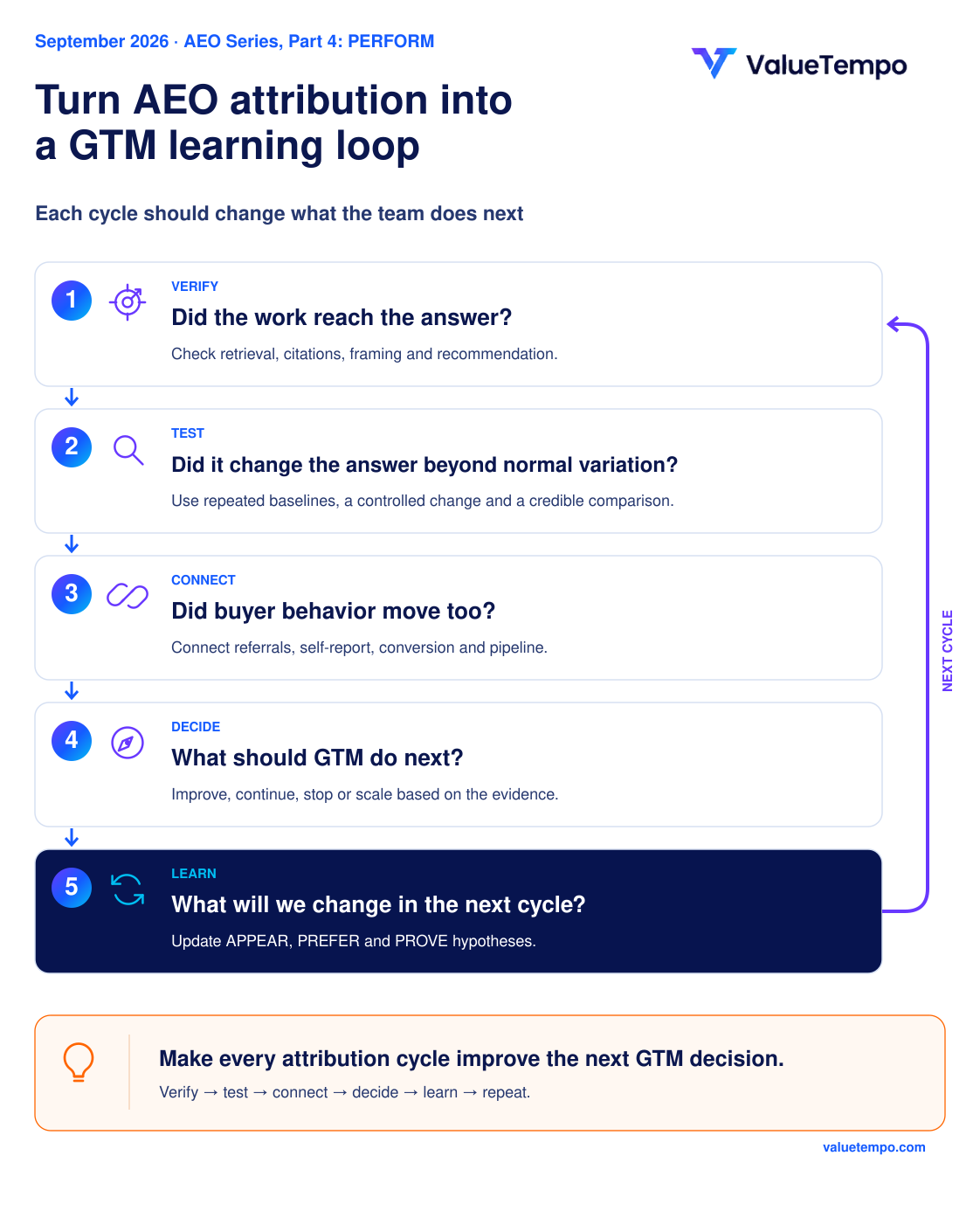
Verify, test, connect, decide and learn: each cycle feeds the next GTM decision.
The four stages now operate as one learning system
APPEAR asks whether the brand reliably enters the right consideration set.
PREFER asks which credible option becomes the first choice and why.
PROVE asks whether the evidence behind that choice supports the buyer's actual requirements.
PERFORM asks what happened next and how the resulting signals should change the GTM system.
The four stages are cumulative, but the buyer journey is not a straight line. A buyer can return to evidence, change the comparison set, consult another engine or bring a new stakeholder into the evaluation.
That is why the objective is not one perfect attribution number.
It is a better next decision.
The purpose of AEO attribution is not to give AI credit for revenue. It is to help the GTM team determine where AI is affecting the buying journey, where that influence stops and what to do next.
The learning loop closes when the signal changes a decision: what to investigate, improve, continue or stop.
That is the commercial path from APPEAR to PERFORM.
Frequently asked questions
What is PERFORM in AEO?
PERFORM is the stage where teams connect answer-engine signals—such as shortlist position, recommendation and evidence quality—with buyer behavior and commercial outcomes. Its purpose is to identify where AI influence advances or stalls and guide the next GTM action.
Is AEO attribution the same as proving AEO caused revenue?
No. Attribution assigns an observed outcome to a source under a defined rule. Causal incrementality asks whether the outcome would have occurred without the intervention. Attribution supports channel operation; causal claims require a credible counterfactual.
Which AEO attribution signals should a B2B company track?
Track answer-state signals, identifiable AI referrals, branded and direct behavior, buyer self-report, lifecycle progression, qualified pipeline and revenue. Keep direct, self-reported, modeled and experimental evidence separate so each signal is interpreted appropriately.
How should a GTM team use imperfect AEO attribution?
Use several signals to locate the constrained transition. For example, visibility without recommendation suggests a positioning or evidence gap; recommendation without buyer action suggests a demand, relevance or next-step problem; traffic without pipeline suggests a conversion or qualification problem.
When does an AEO team need an experiment?
Use a controlled comparison when the decision requires estimating the intervention's incremental effect—particularly for scaling a tactic, reallocating meaningful budget or claiming incremental pipeline or revenue. Smaller reversible improvements can begin with repeated answer observations and a clearly defined success condition.
Does PERFORM require perfect revenue attribution?
No. PERFORM requires that the claim remain proportional to the evidence. A lean team can begin with answer monitoring, direct referrals, self-report and CRM outcomes, then add matched comparisons or experiments as the decisions become more consequential.
Research scope: ValueTempo's VAT-compliance experiments measured answer-engine consideration, preference and evidence use; they did not include human buyers or commercial outcomes. External observational and operational studies connect AI exposure with browsing, referrals and conversion cohorts. The cited natural experiment provides suggestive intervention evidence but does not establish a universal AEO effect. No source reviewed establishes a general causal effect of AEO on B2B pipeline or revenue.
Also read:
Part 1 — APPEAR: Being Cited Is Not Being Chosen: How AI Answer Engines Build B2B Consideration Sets
Part 2 — PREFER: From Consideration to Preference: How AI Answer Engines Choose Among Credible B2B Options
Part 3 — PROVE: AI Keeps Recommending Your Brand. How Strong Is the Case Behind It?